


Public radio has experienced a crippling 30% drop-off in listeners. The official explanations focus on general changes in radio listening patterns, which while true, don’t go far enough in grappling with a decline that is worse for National Public Radio than almost all other broadcasters. In the previous post I examined the many stories that NPR has dedicated to the issue of “white supremacy”, which they define broadly. In this post I examine how the omnipresent narrative of racial disparities in mortality outcomes, while often true, are often misapplied by NPR and others to misleading and alienating effect.
Disproportion
During the first two years of the Covid-19 pandemic there were sharp racial disparities in mortality. The greater death rates of Blacks and Hispanics was an important story to cover, and it was covered extensively. But by 2022 covid mortality by race had flipped, as reported in the Washington Post. NPR’s Michelle Martin conducted an excellent interview with one of the Post writers, which is, as far as I could tell, was the only time NPR mentioned that the disparities in the pandemic now ran in the opposite direction. NPR ran stories which practically begged for inclusion of this fact, but it was never included. Covid was now killing proportionally more white Americans.

While that particular interview was an example of excellent journalism, as typical of Martin’s coverage, NPR has gone on to make several misstatements about the pandemic’s disproportionate toll on Black and Latino people. It is true that age factors into covid deaths and white people are older than Black and Hispanic Americans, but it is also true that people grieve the death of loved ones no matter their age. It is undeniably a legitimate story when Black and Hispanic people were more likely to die of covid, but it doesn’t cease to become a story when white people are more likely to die. Simply updating or correcting mis-impressions is a legitimate task of news. The ratio of NPR’s stories about the racial disparities of covid comparing the time when people of color were dying at greater rates to the time, including the present, where white Americans are more likely to die is over 100:1.
By the way, a top search result, for “covid deaths black hispanic” was the Atlantic’s collaboration with Ibram X. Kendi’s Boston University Center for Antiracist Research. It has out-of-date data, a misleading headline, and a link to federal data that is broken.

Don’t you think at this point the University should take the page down?
Kendi is also the author of this 2019 article :

Equating white privilege, white supremacy or just whiteness to longevity is a common sentiment, versions can be read here, here, here, and, by Kendi once again, here.
But before the pandemic began the underreported fact was that white Americans had a lower life expectancy than the American average.
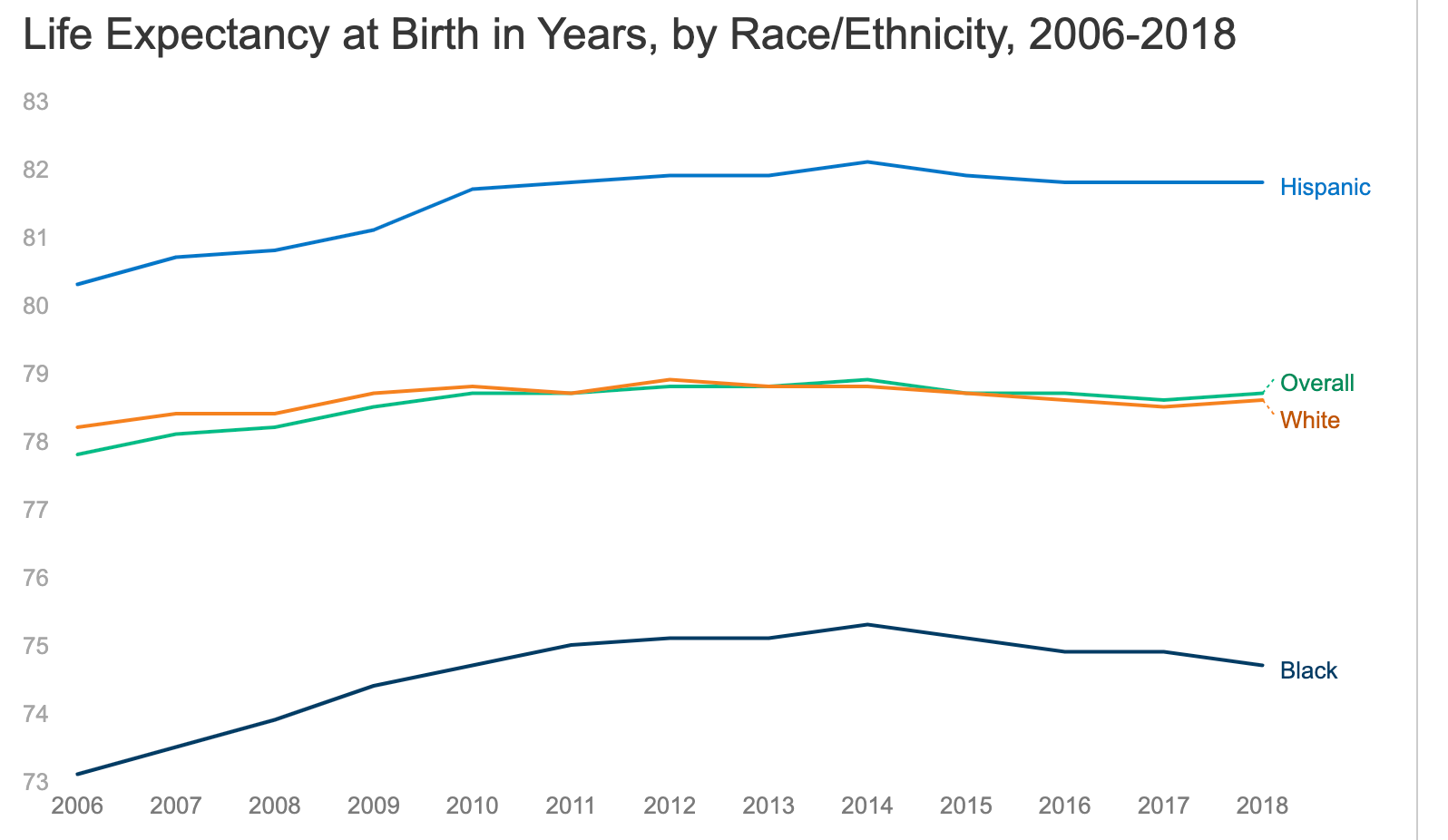
The gap between the life expectancy of the average white person and the life expectancy of the average person of color wasn’t huge, just a fraction of a year most years, but it was the case that being white correlated to a shorter, not longer life.
The reasons for people of color living longer lives than whites came down to two main factors: Asian-Americans live much longer lives than whites, and Hispanics live significantly longer lives than whites. The Asian and Hispanic communities are growing, those two populations currently account for nearly double the number of Black Americans and Native Americans, two groups with shorter lifespans than whites.
It is very common for purveyors of the “white supremacy = white longevity” argument to gloss over, or flat out ignore the Hispanic experience. For instance this 2022 “sweeping study of racial inequities” (according to the press release) called white supremacy ”the root cause of racial health inequity in the United States.”, while barely considering the Hispanic experience. It includes 153 references to Black health outcomes, and fewer than 5 to the health of the Hispanic or “Latinx” population. The Stat News article, “The Supreme Court’s affirmative action decision puts lives at risk”, is horrifically inaccurate. I can’t explain how a journal dedicated to statistics could get it so wrong, except to surmise that no double-checking was done when the authors lumped Hispanic death rates in with those of Black and Native Americans.
Life expectancy in America has mostly rebounded since Covid, but it will take a while to see if the trend of people of color outliving whites reverts. The latest mortality statistics show that white people are not only dying in larger numbers (to be expected because they’re older) but even in higher numbers than people of color when adjusted for age. Life expectancy calculations, which are an estimate, rely heavily on death statics, which are not.

This realization was so shocking to me when I discovered it on my own from looking at data and piecing together statistics, that I think it at leasts deserves its own subhead
For 6 of the past 8 years People of Color Had Longer or the Same Life Expectancies as White Americans
On NPR the opposite impression is given. As far as I can tell NPR has never reported on the trend of white people having a shorter life expectancy than the average American. Sometimes they get these facts flat-out wrong as with this segment:
This figure tracks with other health trends: In general, Black and Hispanic people and those living in poverty in the U.S. have worse health outcomes — more high blood pressure, higher rates of diabetes and increased maternal and infant mortality — than the overall population.
In fact, Hispanics actually have less high blood pressure and lower maternal mortality rates than Whites and than the overall population (the links to these studies are actually just the ones sited by NPR, incorrectly).
The health and longevity of Hispanics, the largest ethnic group other than whites is so often ignored, misstated, or elided as to contribute to a false belief in what I think is the fundamental benefit of so-called white supremacy, that it confers a health status superior to non-white Americans. This is not to say that there isn’t systemic racism, and systemic inequalities. But those are provable, not a theoretic framework-cum-catch-all buzz phrase. Of the three ideals encapsulated in the phrase “life, liberty and the pursuit of happiness” the only one that can be empirically measured is life, and accurate measures indicate that whites have been doing worse on it than their minority counterparts.
The explanatory power of the “white supremacy” theory in explaining mortality and longevity is clearly lacking, but NPR goes back to it time and again. And while it is true that NPR is not the worst offender among U.S. media outlets, NPR prides, or prided itself on being better than “not the worst”. They have historically been a more informative, more interesting alternative to the inadequacies of much of U.S. media, but that’s no longer NPR’s niche, which is a key reasons why listeners are literally tuning out.
Mike, I think you're right according to the numbers. However, as an octogenarian white man, I truly believe that I have experienced a lot of "good luck." I suspect that there are tranches of white folks who have truly been privileged. I'm one of them. I grew up in a blue-collar, lower socio-economic environment, but because of "whatever" managed to get an education and escape. I believe my escape was helped along by my privilege. Rob Henderson is another example - both he and I are "smart." We were readers and our teachers and others recognized us and we got the occasional break that folks of color and less gifted white folks received less of.
If you're white, not very bright and happen to have been brought up in the rust belt, and as technology removed most of the opportunity that used to be there, well it can seem like "somebody" or "something" has taken away the privilege that used to exist for us white folks. It pisses people off.
Anyway, what I'm saying is, the numbers are correct, but there's a lot more fine structure underneath than just ethnic background.
Wow, it is nice to see this from Mike Pesca! I was a long-time Slate subscriber and Pesca fan, but I switched them off several years ago because I want to be informed, not brainwashed. Not that Pesca ever tried to brainwash me. Rather, I was frustrated that he never mentioned the fact that his colleagues were trying to.
Maybe I'll give him another chance.